I'm actually surprised you haven't yet tried pulsed illumination to combat the severe slow-down of pausing at each position....
If you have a PI5 on the camera it should manage over 20 fps.... (at full resolution) https://forums.raspberrypi.com/viewtopic.php?p=2227660#p2227660.
The trick would require rather effective strobe-centric illumination though; for continuos motion along the 3040px direction you'd be looking at flashing for about 13 microseconds duration with a full frame worth of photons.
"Just" needs pulse-shaped excitation or an active reverse current pulse on end-of-pulse to rapidly stop the glow.
Oh, also, that's math with 0% overlap between images; I'm assuming you're doing substantial overlap for post-processing alignment and such purposes.
The harder part I guess is that 99.9% to 99.99% of light need to happen within that short single-line-duration of the frame.
So dark surroundings and driving the strobe to be very much dark at the other times.
Thankfully I think a simple series resistor (current limiting) drive with a simple half-bridge would do. The active-low drive discharges the stray capacitance in the LEDs and the rest of the circuit to prevent them from emitting light.
Also probably annoying to look at with this meager frame rate the only-half-the-lanes setup causes
@namibj - I have the random idea of treating the microscope / camera more like a satellite continuously moving over the earth and using a lot of the signal processing those guys use to generate images.
Tim 'mithro' Ansell
@namibj - I have the random idea of treating the microscope / camera more like a satellite continuously moving over the earth and using a lot of the signal processing those guys use to generate images.
There is a bunch of fancy maths that lets you take the continuous stream of the pixel data, the information about the rough velocity, and the relative pixel position to do super resolution / reverse convolution reconstruction of what things must look to produce the pixel data.
Yeah you can do, it's just that some of the sample noise of the image sensor with a photodiode well that integrates during sampling interval is increased at increased count
This sounds really useful, and I am looking forward to seeing such a system running. Unfortunately, I don't have neither time nor energy to invest into one more project at time moment
no I mean I have no idea how you're set up from a POV of geometric optics for illuminating those dies relative to the geometry/space blocked by your "camera"'s ("microscope's") "front lens assembly" ("objective").
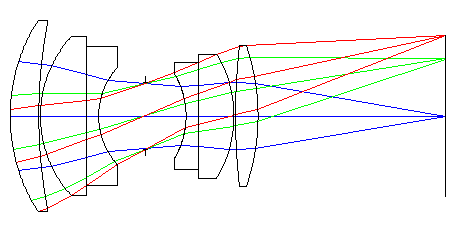
like in theory you would get those 1.55um pixels with a plain 1:1 lens assembly, like a symmetric https://en.wikipedia.org/wiki/Double-Gauss_lens for example, with given the pixel size and all, I'd say about NA 0.2 to 0.3 for full visual spectrum coverage.