Guild icon
wafer.space Community
Information / general
Welcome to wafer.space - documentation at wafer.space github - buy at buy.wafer.space - archives at discord.wafer.space
Between 06/30/2025 23:59 and 08/01/2025 00:00
Avatar
I've begun work on a SCL for gf180mcu using 3.3V transistors
23:56
I created an inv_2 cell and characterized it using the exact same parameters for input slew and output load as I did for the inv_2 cell in my sky130 SCL and got promising results.
23:56
3.3V gf180 is at least as fast as sky130_fd_sc_hd
๐Ÿ‘€ 1
23:56
But most likely faster
23:57
It trades punches with my sky130_as_sc_hs SCL, which outperforms fd_sc_hd by a wide margin.
Avatar
I have all the cells that I need for yosys and OpenLane to do their things, except a D-Flip-Flop. That one is gonna take a bit. I always struggle with them a bit.
blobclap 4
Avatar
Tim 'mithro' Ansell 07/04/2025 17:41
@Tholin - Awesome work!
Avatar
DFF done. About to test it all in a flow for the first time. And then its time for an initial commit to GitHub.
๐Ÿ‘ 1
19:55
Gimme a minute for the commit
Avatar
Apologies for the delay. I encountered some DRC errors, but I canโ€™t test my changes because OpenLane continues to use the previous version of the cell layout files. I donโ€™t know where its getting those from, they are long overwritten. Sadly, I donโ€™t remember what I did to fix this issue the last time I had it.
Avatar
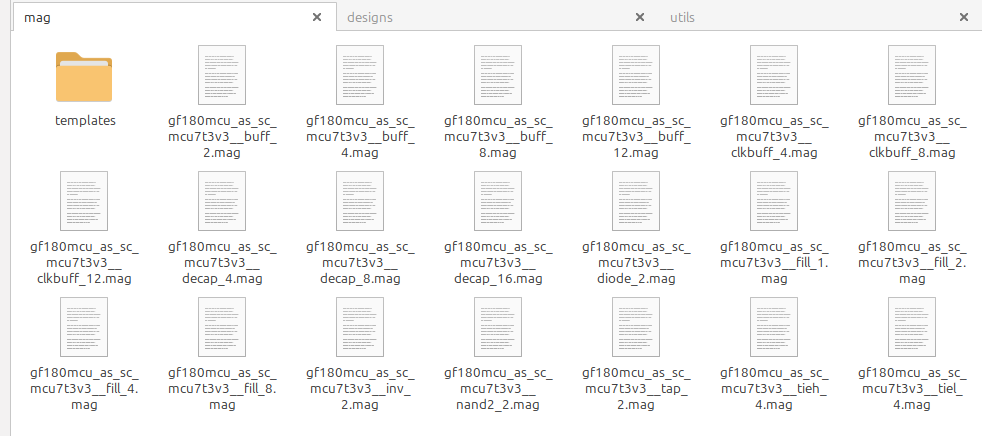
Custom Standard Cell Library for GF180MCU process node on open PDK. - AvalonSemiconductors/gf180mcu_as_sc_mcu7t3v3
15:41
And with that, the hardest parts are actually already behind me. The project is now in the "smooth sailing" phase where I can just add more combinatorial logic cells in whatever order I like.
๐Ÿ‘ 1
๐ŸŽ‰ 3
15:42
And since I've done this before, I can copy my own work from sky130_as_sc_hs
๐Ÿ‘ 1
Avatar
Progress on the SCL has been halted for two days now because I added a mux2 cell and even though nothing appears bad in the liberty file, the GL tests fail unless I disable this cell. Yosys is simply synthesizing bad logic when the mux2 is defined. If anyone has any leads on this, please reach out.
Avatar
you could try asking here: https://yosyshq.discourse.group/
A place to discuss YosysHQ software and tools
Avatar
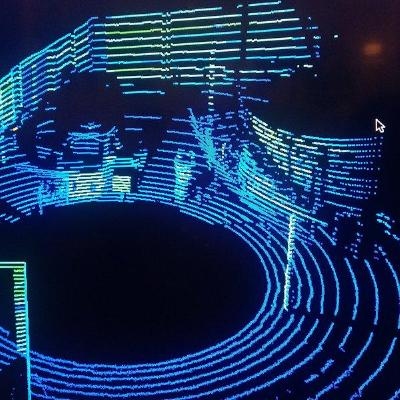
Here, ya'll might get a kick out of this. The AS2650v2 is a custom MCU/CPU I taped out for GFMPW-1 and on one of the test boards for it, I created this demo. I actually did this almost a year ago, I only just bothered to record it. https://www.youtube.com/watch?v=8YNhw6dvOw4
๐Ÿ’ฏ 2
๐Ÿฆ„ 2
18:47
Audio also generated by the AS2650v2, but recorded directly from the DAC output. That piezzo is...not good.
Avatar
@Tim 'mithro' Ansell nice seeing you at open sauce... Hopefully I can find a way to contribute to the first wafer.space shuttle.
๐Ÿ‘ 1
Avatar
SCL update: ran a flow on a custom RV32IM core with a tweaked config to optimize for delay to see how far I can push it speed-wise and ended with an fmax=105MHz, while retaining the same density as the 7-track 5V cells. If I let the fmax drop and optimize for area, on the other hand, my SCL has a noticably higher density than the 7-track 5V cells. And this is all before I added most of the aoi combo cells I planned, so this is likely to improve even more as I keep working. I also have to add that this is not a good RISC-V core I'm compiling here. Its something I threw together in a few hours. Architectural improvements could easily throw this past the 150MHz mark right now.
๐Ÿ’ฏ 1
17:01
Another note is that I am testing my SCL against RTL from one of my GFMPW-1 submissions, which means it uses caravel_user_project and OpenLane 1. I don't know what the recommended setup for wafer.space will be, but I assume LibreLane and an OpenFrame-equivalent? I'll still need to test my SCL against LibreLane and see if that also yields performance improvements.
Avatar
In other news, I've also started collecting ideas on things I can put onto my submission for the first shuttle. I am planning to again do a multi-project die. The ideas list is quite long by now. I will soon pick out a handful of them and start writing up requirements documents so I can start implementation work the moment the deadline becomes known. I can share a bit of this list if anyone else still needs inspiration.
๐Ÿ‘ 2
Avatar
Leo Moser (mole99) 07/27/2025 07:30
I would expect LibreLane to be used for wafer.space submissions. That's where future development takes place, and it already has quite some nice features (and bug fixes) compared to OpenLane 2 (not to mention OL1). Ultimately it depends on the users how they create their layout, but IMO LibreLane should be the recommended path. There is of course the existing pad frame from the GFMPW shuttles at Efabless, which is going to be used for the first wafer.space shuttle run. I'm working on an OpenROAD.PadRing step for IHP, which should work for GF as well, since the IO pads are really not that complicated (compared to e.g. sky130...). This would make it possible for each submission to wafer.space to have a different die area, which would of course require a more sophisticated reticle stitching. I would assume there to be one or two standard sizes to enable cost-effective packaging of the dies (if needed).
Avatar
When you say using the existing pad frame from GFMPW, does that mean caravel including the management controller? I have my own (not so good) opinions about caravel, but I don't think I'll be able to test my 3.3V SCL effectively without changes to the IO pads, which I already volunteered to look into sometime soon.
Avatar
TL;DR the existing IO pads are really slow at 3.3V, so pads specifically geared for 3.3V IO voltage (I assume using the low-voltage FET devices instead) is something that is desperately needed.
Avatar
Leo Moser (mole99) 07/27/2025 13:28
No, just the pad frame without Caravel. That should work for most submissions. However, if you want to create your own pad frame, feel free to do so. What matters is that the die size stays the same, as that will make the reticle stitching easy.
Avatar
and probably use the same position for the wirebond, otherwise you'll have a much higher NRE for doing packaging
Avatar
Leo Moser (mole99) 07/27/2025 13:39
Yes, although I think Tim wants to try CoB where such changes could be more easily accommodated?
Avatar
I really don't understand how programming a CoB machine is cheaper than programming a wire bonder for QFN ... the packaging made by swissbit is literally doing CoB since they use a PCB as the substrate , so if you find someone that does CoB cheap, why can't they do the same thing as swissbit ?
Avatar
I thought wafer.space won't do packaging? Raw dies only?
13:51
I was already looking into options for getting dies packaged on my own.
13:52
Anyways, yeah, that sounds good. So its basically OpenFrame, but for gf180.
13:52
Hmmmm
13:53
Yeah, if I make custom IO pads, I can arrange them in the same pattern as is required.
Avatar
Avatar
tnt
I really don't understand how programming a CoB machine is cheaper than programming a wire bonder for QFN ... the packaging made by swissbit is literally doing CoB since they use a PCB as the substrate , so if you find someone that does CoB cheap, why can't they do the same thing as swissbit ?
Leo Moser (mole99) 07/27/2025 13:54
I was thinking more along the lines of doing a few pieces with a manual wire bonder, like you guys did with TT-CoB. That should be enough to verify Tholin's standard cells. Anyway, Tim will have to tell you what he actually has planned for the packaging.
Avatar
Avatar
Tholin
Anyways, yeah, that sounds good. So its basically OpenFrame, but for gf180.
Leo Moser (mole99) 07/27/2025 13:55
Yeah, kind of OpenFrame but you can change the IO pads.
Avatar
I still gotta understand how the current IO pads work. I took a look at the files in the PDK, but they're very complicated. So I think I'll have to make it a weekend project just to read into the topic.
14:04
Are there any additional files for these sitting in a repo somewhere that are not part of the PDK download? xschem schematic files would be incredibly helpful.
Avatar
Leo Moser (mole99) 07/27/2025 14:04
Let us know your progress, I'm interested in that too ๐Ÿ˜€ But you're in luck, compared to sky130, the IO pads in gf180mcu seem to be pretty straightforward.
14:05
I don't think that schematics exist, same as on sky130. Mitch even created the schematics for some of the IOs in sky130.
14:11
Here is the repository for Mitch's gpiov2 cell on sky130 as a reference: https://github.com/d-m-bailey/sky130_fd_io
Avatar
One of the cells in the PDK is marked "gf180mcu_ef_io__bi_t". An efabless engineer created it?
Avatar
Yeah, it just exports the ana signal they needed for caravel for analog stuff mixed with a digital io ...
14:16
(which is not something that exists in the default io cell)
Avatar
Ah. Well, that sucks.
15:05
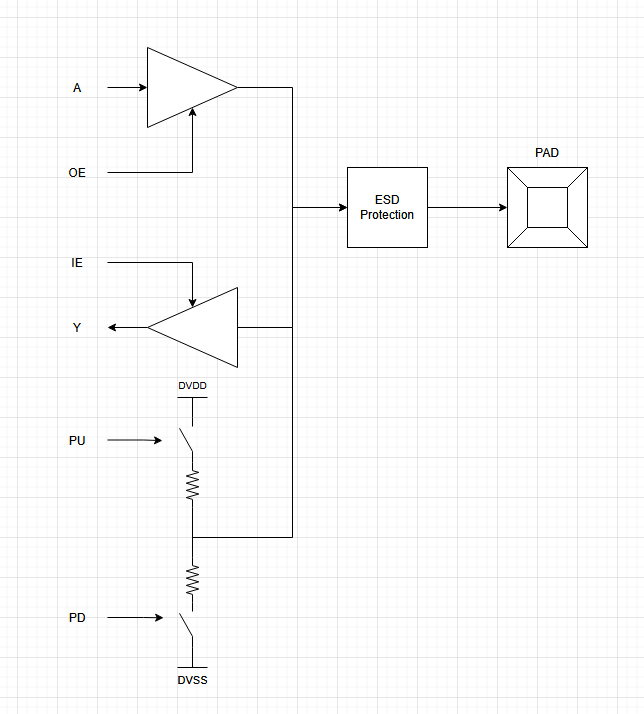
But yeah, the functional schematic does look like the simplest possible bi-directional buffer one can build.
15:06
The only concern I have is that activating PU and PD at the same time appears to generate a short circuit.
15:10
Actually, it appears to have some additional complexity in the form of the slew rate and drive strength control lines on the output buffer and the Schmitt Trigger enable on the input buffer. Wondering if we really need those for most use cases. Definitely a nice-to-have, but not something I can imagine ever needing myself.
Avatar
Going to build this for now. Nothing fancy. I'll see about experimenting with more advanced features once I get the hang of things.
๐Ÿ‘ 1
Avatar
Leo Moser (mole99) 07/27/2025 16:19
Just asking because I don't know any better: Is it not possible to just replace the HV transistor with LV transistors directly in the layout of the IO pads?
Avatar
Technically yes, but the LV transistors obviously have different characteristics than the HV transistors, which concerns me.
16:40
I know that there is liberty files with characterizations of the IO pads, which I also need to figure out how to generate.
Avatar
Iโ€™ve begun reverse-engineering the existing IO pads. Going to record the information in a google doc soon.
Avatar
GF180's 5V IO compatibility is one of the thing making that process interesting. So making IO pads that perform properly at 3.3V while maintaining is what's really needed, along with proper separation of IO and core voltages.
Avatar
The output drivers on the IO pads actually use the even higher voltage 6V FETs
18:00
Which explains why they perform ultra poorly at 3.3V
18:05
But makes sense. Gives the chips some upwards margin when operating at 5V.
Avatar
Leo Moser (mole99) 07/27/2025 19:06
From what I've heard those aren't different devices, but just a different model for a specific W/L. But yeah, they could probably be downsized then.
Avatar
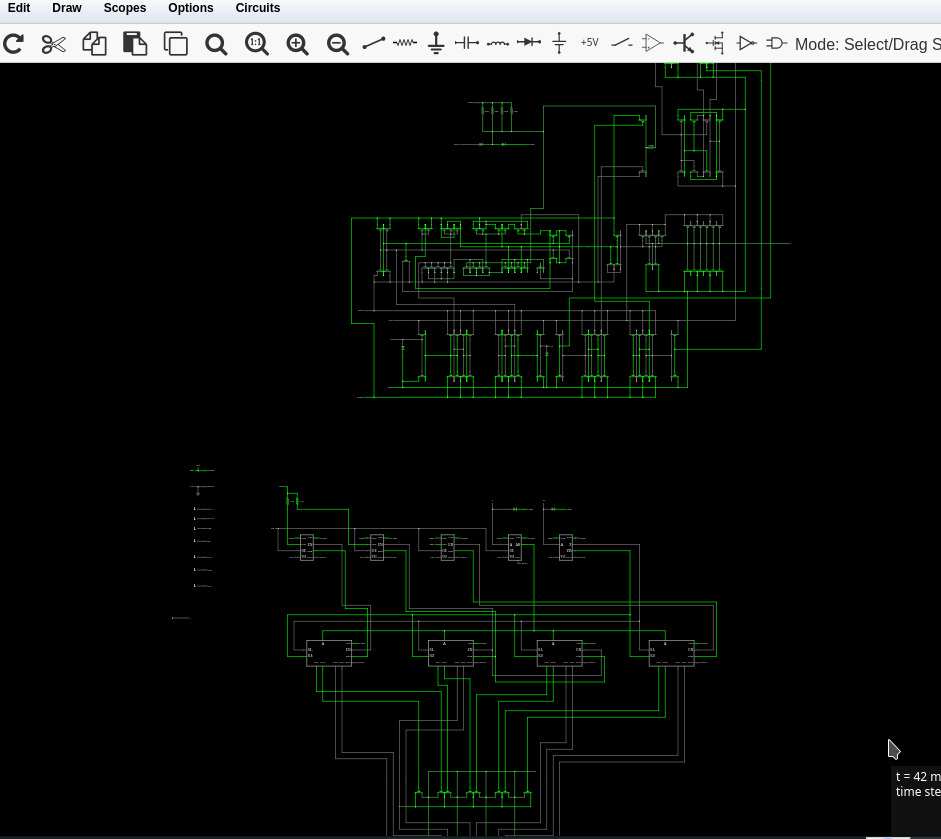
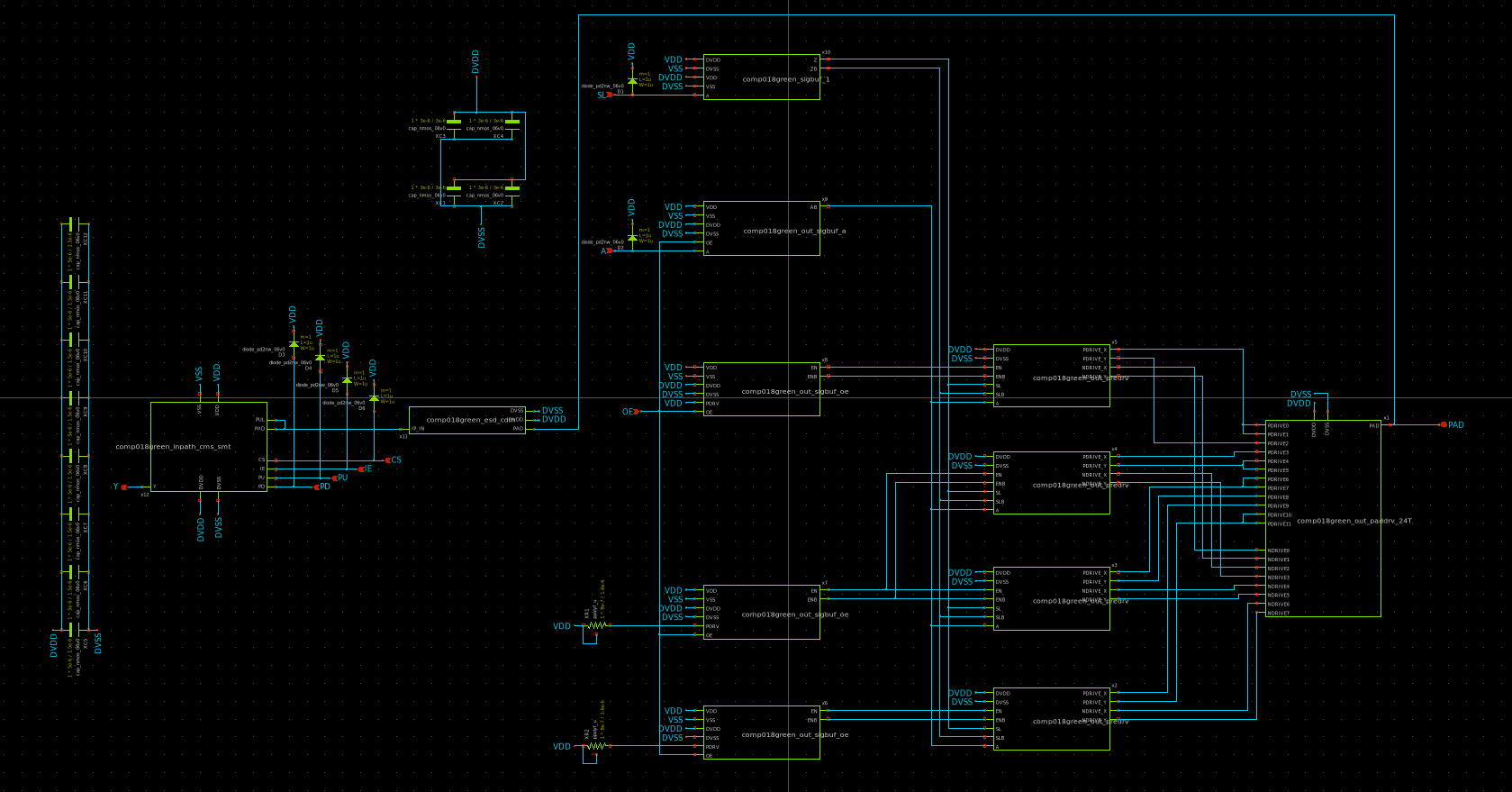
I present to you: a complete reverse engineering of gf180mcu_fd_io__bi_24t
23:07
This is a purely "functional" schematic. I did not yet record specific device properties like FET width and length.
23:07
Turning this into xschem files is next.
23:07
Top is the input path, bottom is the output path.
23:08
I think there is still a few things I got wrong, but Iโ€™ll tweak them tomorrow.
23:09
For my purposes, I technically donโ€™t need to go and make accurate xschem files, but I feel like others will find the information useful.
23:09
A couple insights
23:10
The concept of having separate IO and core voltages actually seems represented in these cells. There is two power rails, "VDD/VSS" and "DVDD/DVSS" and a majority of the transistor count here is actually just extensive buffering to translate between the two power domains.
23:11
There is also significant amounts of protection diodes on internal signals, which makes no sense to me unless said signals cross power domains.
23:14
Iโ€™ve just spent all day staring at Klayout dissecting layouts, so logging off for today.
Avatar
Leo Moser (mole99) 07/29/2025 05:07
Nice work!
05:09
Yes, the IO cells were designed for separate power domains. However we only got the 5V standard cell library open sourced. Thus the power domains were tied together afaik.
Avatar
They do not appear to be tied together inside the actual IO cell layout, so if they are, its somewhere else on the chip.
07:33
In either case, it doesnโ€™t look difficult to untangle the power domains.
07:35
However, the 6V transistors used in the output buffer are really terrible at switching 3.3V onto the pad, which weโ€™ve practically observed as well. But we know that the 5V FETs are snappy enough for logic circuits, even when powered at 3.3V. So, really, the only thing in the IO cell that needs modification is the final pad drivers. (edited)
07:36
And in particular, youโ€™re looking for something that can do 5V just as well as 3.3V. I have an idea, but let me run some simulations first.
Avatar
They are tied together by the actual dvdd / dvss pad cells.
08:19
But the tracks inside the IO cells that carry vdd / vss look pretty weak to me. Only ~ 13.5u total width.
Avatar
Makes sense. vdd/vss is the core voltage and just used to power some buffers. dvdd/dvss is the IO voltage.
Avatar
In the other techs you still have decently beefy rails for it since the ring in the IO is used to also feed power to the core. Those rings being wimpy here means the added rings in the core will need to be beefier since they'll have to do the whole job.
Avatar
Okay, done
15:59
Avatar
Did you test if it pass LVS against the extraction ?
Avatar
Nope
16:08
I would not know how to do that.
Avatar
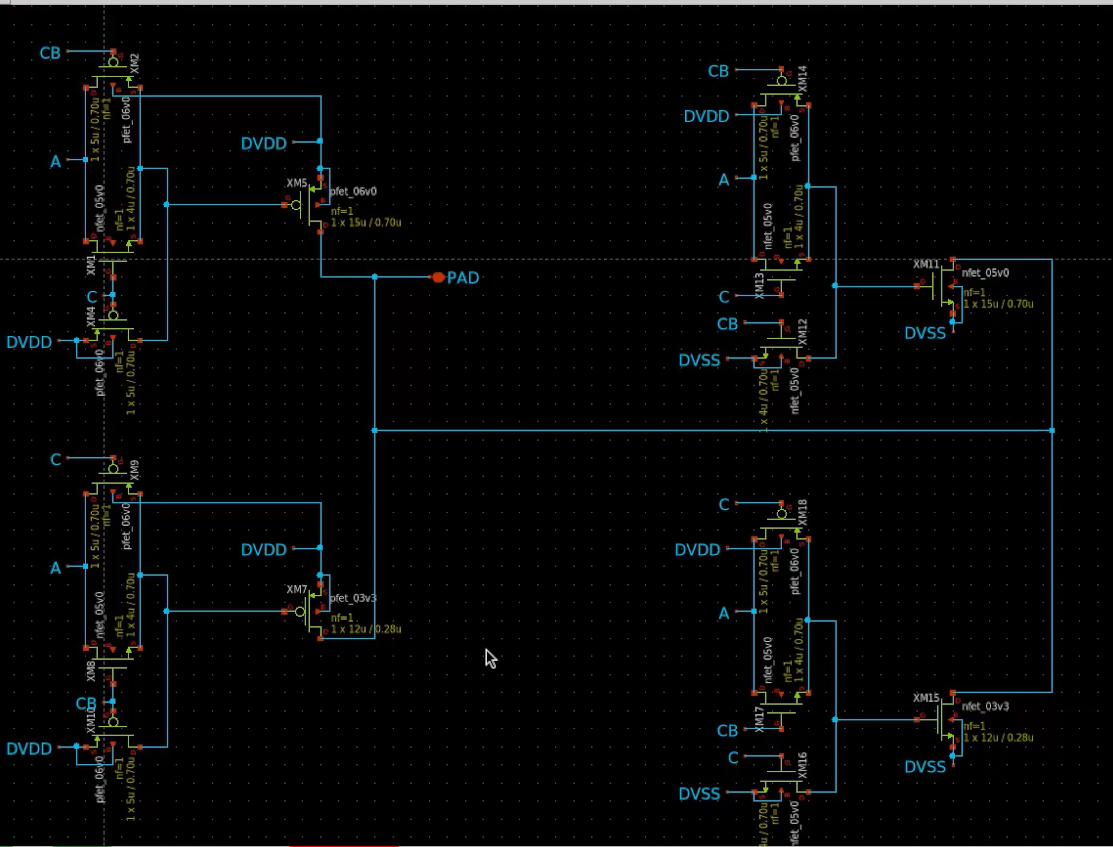
Okay, so, I had the idea of making an IO pad driver that uses transmission gates to re-wire itself and switch between using high-voltage or low-voltage transistors based on the chip's supply voltage. I threw something together in xschem and simulation looks good on that idea.
Avatar
huh ? I have trouble seeing how that would work. Adding a transmission gate in series would surely be worse than using the 5V transistor at 3v3 ...
Avatar
Not like that
20:56
Its easier I just show
20:56
20:56
This is simplified. Theoretically, XM5, XM7, XM11 and XM15 could be entire banks of FETs in parallel, just how it is on the actual IO pads.
20:57
The transmission gates decide which tansistors get the buffer input signal on their gate, and which are disabled.
20:57
For disabled transistors, it is ensured that the potential difference between their gate and body is 0V.
Avatar
But you're exposing the 3v3 transistor drain-source to > 3.3V which they are also not rated for.
Avatar
From what little specs we have on these FETs, this should work.
20:59
Where does it say that?
Avatar
Actually you're exposing the gate to 5V. The transistor are symmetrical, no difference between D and S so when you have the gate at 0V and the "drain" at 5V, you have a 5V potential difference between the gate and drain.
21:02
Do we really have some concrete numbers on what the FETs are able to tolerate?
21:03
The closest thing I can see in the docs is 5 Punch-Through Voltage, which is higher than a 5V difference even for low-voltage FETs.
Avatar
No, not really.
21:06
Maybe @Tim 'mithro' Ansell has access to some SOA.
Avatar
I can also just tape it out. Not as a proper IO cell, just that test circuit somewhere on the die. See what happens.
Avatar
But by that spec you might as well just use the 3v3 transistor at 5V all the time ๐Ÿ˜…
Avatar
I mean....we can try.
21:08
My plan for the first shuttle here is it to tape out a 3.3V chip using my SCL and custom IO pads for 3.3V operation.
21:08
I can sacrifice a few to 5V experiments.
21:14
I don't think they'd immediately die at 5V, I think it's more accelerated degradation and might only show on some percentage of a chip after hundreds or thousands of hours ...
Avatar
Okay, so, basically, we don't know exactly what'd happen.
Avatar
Tim 'mithro' Ansell 07/29/2025 23:14
I'm sure someone might but I wouldn't trust their answers until it was verified with a real tape out.
Avatar
It would be good to have those estimates anyways. But yeah, I can absolutely tape out some test structures.
Avatar
So, this is kindof an important question for what I wish to do: if customizing the types of IO pads in the pad ring is on the table for wafer.space, does that mean we get access to analog IO (which was frustratingly not a thing on GFMPWs)?
Exported 114 message(s)
Timezone: UTC+0